간접화법 (Gan-jeop-hwa-beop): Korean Has Four Ways to Say "He Said That" — and Each One Means Something Different
You learned -다고 하다 (da-go ha-da). You felt ready. Then a native speaker casually dropped 선생님이 읽으라고 하셨어요 (seon-saeng-nim-i ilg-eu-ra-go ha-syeoss-eo-yo, "The teacher told us to read it"), and that single -라고 sent you back to square one.
Here is what your textbook did not tell you: Korean 간접화법 (gan-jeop-hwa-beop, "indirect speech") is not a quotation system. It is a classification system. Every time you report what someone said, Korean requires you to make a judgment call — was that a statement? A question? An order? A suggestion? Then it demands you prove your answer inside the grammar itself.
English lets you off the hook with one word: that. Korean does not. And that difference is not arbitrary — it reveals something genuinely interesting about how the language thinks.
Why English Intuition Breaks Here
When learners first meet 인용 (in-yong, "quotation"), the instinct is to find a Korean equivalent of that and move on. Reasonable instinct. After all, English handles "He said that he was leaving," "She asked that I wait," and "He told me that I should go" with the same connector.
Korean grammar treats this as a category error. The language requires you to re-examine the original utterance — not just its content, but its communicative intent — and encode that intent directly into the sentence-ending suffix. The suffix is not decoration. It is evidence of your interpretation.
This is where the real insight lives: when you use the wrong indirect speech ending in Korean, you have not simply made a grammar mistake. You have reported something entirely different from what was said. Swap the question marker for a statement marker, and the person who asked "when are you leaving?" becomes someone who announced a departure time. The grammar is the meaning. There is no separating them.
The Four Tracks: Read the Signal Before You Depart

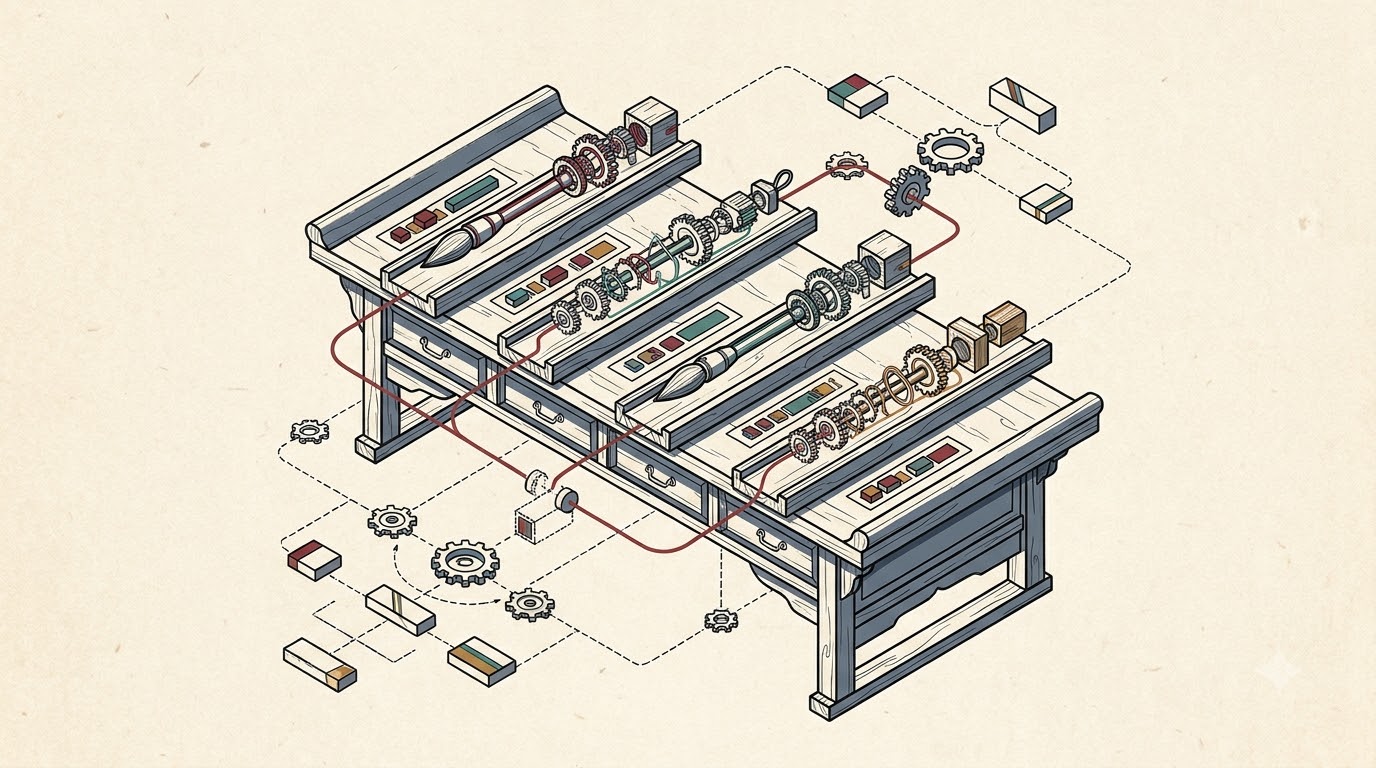
Think of Korean indirect speech as a railway junction. Every original sentence arrives at the junction, and you must read the signal correctly before it can depart on the right track.
Track 1 — Statements (평서문, pyeong-seo-mun)
When someone states a fact or shares an opinion, you use -ㄴ/는다고 하다 for action verbs, -다고 하다 for descriptive verbs, and -(이)라고 하다 for nouns.
친구들이 내일 간다고 해요 (chin-gu-deul-i nae-il gan-da-go hae-yo, "They say they're going tomorrow").
민수가 학생이라고 해요 (min-su-ga hak-saeng-i-ra-go hae-yo, "Minsu says he is a student").
This is the track most learners encounter first — and then mistakenly apply to every other situation.
Track 2 — Questions (의문문, ui-mun-mun)
When the original speaker asked something, you switch to -냐고 하다 (nya-go ha-da). This suffix does not merely report words. It grammatically encodes the act of asking — the way English shifts from say to ask, except Korean builds it directly into the ending rather than changing the verb.
어머니가 언제 오냐고 하셨어요 (eo-meo-ni-ga eon-je o-nya-go ha-syeoss-eo-yo, "Mother asked when you were coming").
If you mistakenly used -는다고 here, you would be telling your listener that mother announced an arrival time. Completely different scene.
Track 3 — Commands (명령문, myeong-ryeong-mun)
When the original speaker gave a direct instruction, you use -(으)라고 하다 (eu-ra-go ha-da).
선생님이 책을 읽으라고 하셨어요 (seon-saeng-nim-i chaeg-eul ilg-eu-ra-go ha-syeoss-eo-yo, "The teacher told us to read the book").
The -(으)라고 suffix is the Korean grammatical equivalent of English told me to. It carries direction and authority, and it is reserved exclusively for commands — not suggestions, not statements.
Track 4 — Suggestions (청유문, cheong-yu-mun)
When the original speaker proposed doing something together, you use -자고 하다 (ja-go ha-da).
친구가 같이 영화를 보자고 했어요 (chin-gu-ga ga-chi yeong-hwa-reul bo-ja-go haess-eo-yo, "My friend suggested we watch a movie together").
The -자고 suffix signals shared action, mutual participation. It is the linguistic fingerprint of a suggestion — and it is grammatically incompatible with commands, because commands are one-directional. Korean will not let you blur that line.
The Noun Trap That Catches Almost Everyone
There is one additional pitfall that deserves its own spotlight, because textbooks routinely underexplain it.
Korean has a grammatical element called the 서술격 조사 (seo-sul-gyeok jo-sa, "predicative particle") — the word 이다 (i-da, "to be") that attaches to nouns to form predicates. When this particle enters an indirect quotation, it does not follow the standard -다고 pattern. It transforms into -(이)라고.
This is the nuance that matters: learners who have been treating nouns and adjectives as interchangeable in quotation structures will produce sentences that sound broken to a native ear. Compare these two:
좋다 → 좋다고 하다 (jo-ta → jo-ta-go ha-da, "says it is good") — standard descriptive verb quotation, no special handling needed.
학생이다 → 학생이라고 하다 (hak-saeng-i-da → hak-saeng-i-ra-go ha-da, "says he is a student") — noun quotation, where the predicative particle morphs before the quoting verb.
Writing 학생다고 하다 (hak-saeng-da-go ha-da) is not just unnatural — it is grammatically broken. The 이 in 이라고 is doing essential structural work. It cannot be dropped the way a learner might casually drop an article in English.
The Contracted Forms You Will Actually Hear
Here is where textbooks and real life diverge most sharply. In everyday spoken Korean, the full forms collapse into what linguists call 축약형 (chuk-yak-hyeong, "contracted forms") — short endings that carry the same grammatical weight in a fraction of the syllables. Native speakers reach for these almost automatically in casual conversation, though like any linguistic tendency, individual speakers have their own rhythms and comfort levels with formality.
| Full Form | Contracted | What It Signals |
|---|---|---|
| -ㄴ다고 하다 | -ㄴ대요 | "They say that..." |
| -냐고 하다 | -냬요 | "They're asking if..." |
| -(으)라고 하다 | -래요 | "They told me to..." |
| -자고 하다 | -재요 | "They suggested we..." |
When a native speaker hears -래요 versus -재요, the distinction registers instantly and automatically. This is the native speaker intuition that intermediate learners are working to build: the suffix is a social signal, not just a grammatical tag. It tells the listener not only what was communicated, but how the original speaker positioned themselves — as someone giving an instruction, or someone extending an invitation to act together.
If you are still using full -다고 하다 forms in casual conversation, you will sound noticeably formal. Not wrong, but stiff — the way reading a grammar textbook aloud sounds stiff.
Try This Right Now: The Retelling Drill
Open any Korean drama, podcast, or YouTube video you have watched recently. Pick three lines of dialogue. Before you write anything, ask yourself these questions about each one:
1. What kind of utterance was the original? Statement, question, command, or suggestion? This classification happens before any grammar.
2. If the original predicate was a noun, did you remember -(이)라고 instead of -다고?
3. What is the contracted form of the ending you chose? Say it out loud three times until it stops feeling strange.
Here is a worked example: a drama character says 빨리 와 (ppal-li wa, "Come quickly!"). That is a command — one person directing another. So the retelling becomes 빨리 오라고 했어요 (ppal-li o-ra-go haess-eo-yo, "They told me to come quickly"). In casual speech: 빨리 오래요 (ppal-li o-rae-yo). Notice how the contracted form feels almost like a different word entirely — which is exactly why listening practice alone will not build this skill without the underlying classification framework.
Three sentences, three classifications, three contractions. That is a complete drill, and it takes under five minutes.
Three Mistakes to Retire Today
① Reporting a question as a statement. Using -는다고 하다 when the original was a question. 언제 가냐고 하다 (eon-je ga-nya-go ha-da) becomes the broken 언제 간다고 하다 (eon-je gan-da-go ha-da) — which now claims the person announced a departure time. The question has vanished from your report entirely.
② Dropping 이 before -라고 with nouns. 학생다고 하다 (X) → 학생이라고 하다 (O). The predicative particle is not optional filler. It is the hinge the whole structure turns on.
③ Forgetting to shift pronouns and perspective. If the original speaker said 나 (na, "I"), you need to re-anchor that pronoun to the new reporting context. Korean indirect speech asks you to reconstruct the scene from the reporter's viewpoint — not replay it verbatim like a recording.
The moment you stop searching for a single Korean equivalent of that — and start asking "what kind of speech act was this?" — indirect speech stops being a wall and becomes a window. Korean is not being difficult. It is being precise in a way English never had to be, because English outsourced that precision to context and tone.
You have the map. Go retell something.
🔊 Pronunciation Guide
Natural-sounding audio for the Korean in this article. Listen, then shadow out loud.
The exact phrases Koreans actually use every day — with the nuance notes that keep you from sounding like a textbook. Delivered as a beautiful PDF, free.
Send Me the Free PDFNo spam. Unsubscribe anytime.