Korean Has 7 Speech Levels — But You Only Need 3. Here's the Map.
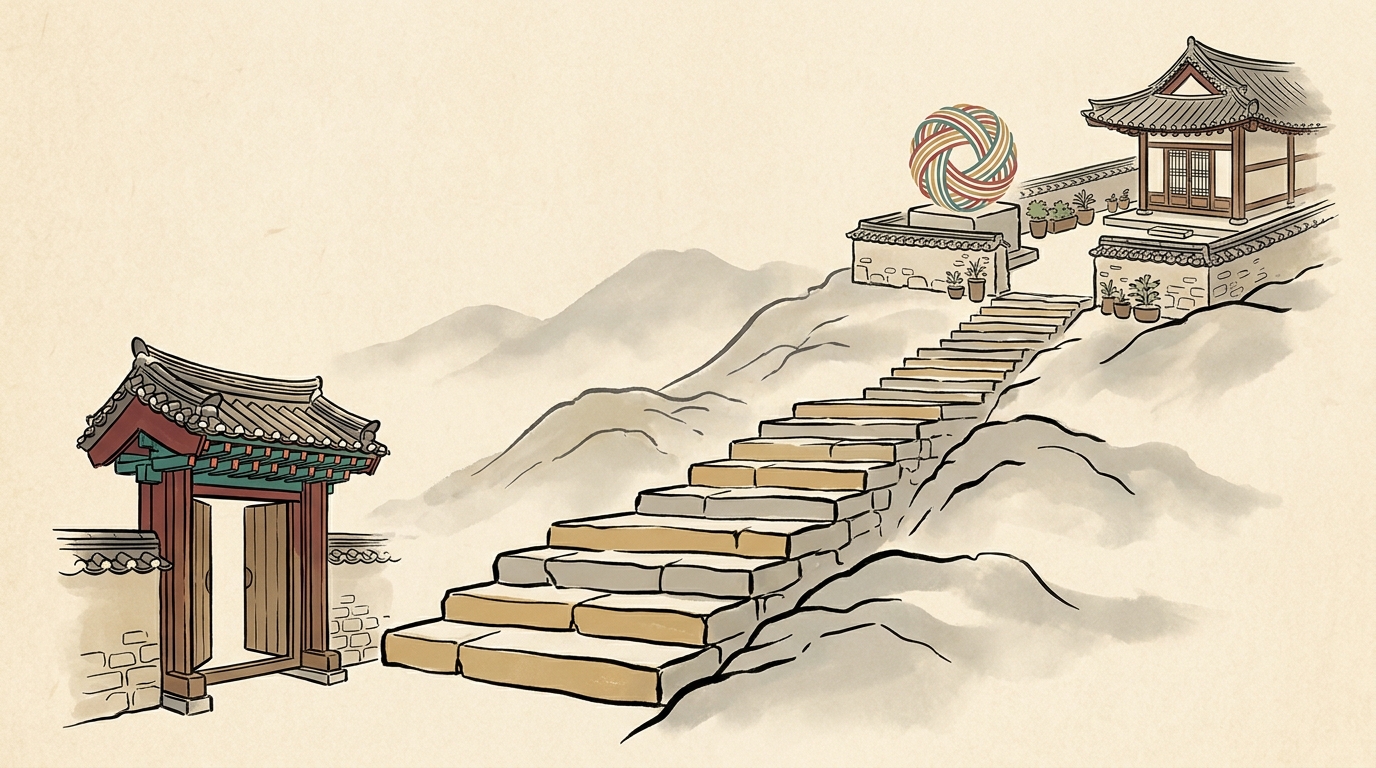
Your textbook handed you 해요체 (haeyo-che) and said "use this, it's polite." That's not wrong. But it's like being given one gear on a bicycle and told you now know how to drive. You can move — until Korean life speeds up around you and you're left pedaling in confusion while everyone else shifts smoothly.
Here's what nobody explains: when a Korean person opens their mouth, they aren't just saying words. They're broadcasting a precise social coordinate — where they stand relative to you in age, familiarity, and situation. The speech level they choose is the signal. Miss it, and you're missing half the conversation.
The Architecture Nobody Teaches: 경어법
The system has a name: 경어법 (gyeong-eo-beop, "the honorific system"). And here's the first thing to understand clearly — 경어법 is not simply "being polite." It's a grammatical architecture baked into the verb endings themselves. You don't add a softening word the way English adds "please." You change the verb form entirely. This means learning Korean and learning this system are, for all practical purposes, the same thing.
Officially, 경어법 has seven distinct speech levels. Linguists count seven when they map the full historical range. But before you close this tab — only three matter for your daily life. Understanding why four levels are fading will actually help you remember the three that remain, so let's take the quick tour.
All Seven Levels: A Thirty-Second Map
하십시오체 (hapsimnika-che) — 갑니다 (gam-ni-da, "I go / [someone] goes"). The most formal register. News broadcasts, business presentations, flight attendants, official announcements. Crisp and institutional.
해요체 (haeyo-che) — 가요 (ga-yo, "going / goes"), 가세요 (ga-se-yo, "you go [respectfully] / please go"). The workhorse of modern Korean. Warm, safe, works in almost every everyday situation. Your textbook was right to start here.
하오체 (hao-che) — 가오 (ga-o). Sounds like a period drama because it basically is. Fading from living speech so fast that most younger Koreans find it jarring. Encounter it in historical films; don't produce it.
하게체 (hage-che) — 가게 (ga-ge). Once used by older employers addressing younger employees. Now mostly literary. Same verdict: recognize, don't reproduce.
해라체 (haera-che) — 간다 (gan-da, "goes"), 가라 (ga-ra, "go!"). The register of novels, newspaper narration, and diary entries. Every Korean short story sentence ending in -다 (-da) is this level. Alive in writing; in speech, it surfaces mainly in commands or interior monologue.
해체 (hae-che) — 가 (ga, "go"), 그래 (geu-rae, "yeah / I see"). The softer face of casual speech — not quite as bare as full 반말, but unmistakably informal. Think of it as 반말 with a thin cushion still underneath.
반말 (ban-mal, "informal speech") — 가자 (ga-ja, "let's go"), 갔어 (ga-sseo, "went"). The language of genuine closeness.
Four of those seven are either dying or restricted to writing. The three that run modern Korean life are 하십시오체, 해요체, and 반말. Everything else is context.
The Three Coordinates Behind Every Speech Choice
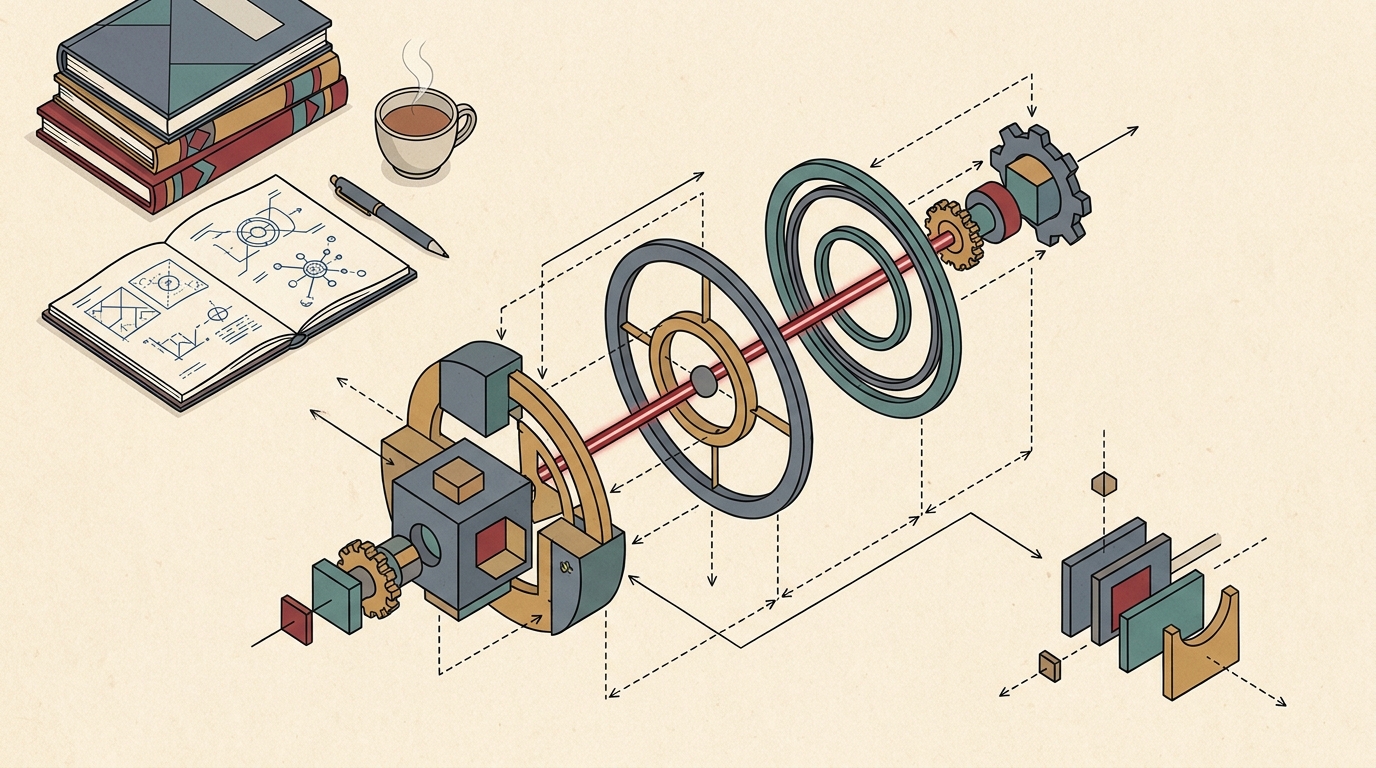
Before we go deeper into those three tiers, you need the map that Korean speakers are running automatically — usually without realizing it.
Every time a Korean person chooses a speech level, they're calculating three things at once:
Age. The most immediate factor. If someone is older than you by even a year in Korean age, 해요체 is your floor. You do not go below it without explicit agreement.
Familiarity. How well do you know this person? A stranger gets 해요체. A close friend gets 반말. The social journey of a Korean relationship is, in large part, the distance between those two points.
Context. The same two friends who joke in 반말 at a café will shift to 해요체 — or even 하십시오체 — the moment one of them stands up to give a work presentation. The people haven't changed. The situation has.
This is why someone you just met at a dinner party speaks to you in 해요체, then turns to their friend at the same table and instantly switches to 반말. It's not inconsistency. It's precision. Korean speech levels are a live social GPS, recalculating with every new interaction.
Your Practical Three Tiers
Tier 1 — 하십시오체: Formal and institutional. Use this in job interviews, work presentations, when serving customers professionally, or any time you're in an official role. This register says: I am performing a public function right now. If you're giving a speech in Korean and you accidentally drop into 해요체 mid-sentence, the audience will notice — not because it's offensive, but because it breaks the register like a wrong note in a chord.
Tier 2 — 해요체: Your daily default. First meeting? 해요체. Shopkeeper? 해요체. Someone older? 해요체. It's polite without being stiff, warm without being presumptuous. You'll often hear Koreans use the word 존댓말 (jon-daet-mal, "respectful speech") to mean this level in casual conversation — technically, both Tier 1 and Tier 2 fall under the 존댓말 umbrella, but 해요체 is the umbrella you actually carry every day.
Tier 3 — 반말: Here's the detail most learners never hear. The "반" in 반말 may not come from 半, meaning half, at all. One theory traces it to 伴 — meaning companion or friend. If that reading is right, 반말 isn't degraded language. It's friend-language. It doesn't lower the other person; it pulls them close. That reframe changes everything about how you should think of it.
말 트기: The Moment a Relationship Officially Changes
There's a specific word for the moment two people agree to drop the formality: 말 트기 (mal teu-gi, "the unlocking of speech"). When it's happened, Koreans say 말 텄다 (mal teo-ssda) — "we've crossed that threshold."
The key thing: Korean people don't quietly slide into 반말. They ask. You'll hear 야, 우리 말 놔도 돼? (ya, uri mal nwa-do dwae?, "Hey, can we just talk casually?") or the gentler 편하게 말해요 (pyeon-ha-ge mal-hae-yo, "Feel free to speak comfortably"). This is a genuine milestone in a Korean friendship — an offer of intimacy, not just a grammatical adjustment. When a Korean person proposes 말 트기 to a foreign learner, it means something.
For learners, this has one non-negotiable implication: do not switch to 반말 on your own initiative. Even if the conversation feels relaxed, even if you think you're close — wait until the Korean person suggests it, or ask directly. Switching without that mutual agreement reads as presumptuous at best, and outright rude at worst. The register switch has to be bilateral.
The Verbs That Shapeshift (And the Marker That Does It)
Korean honorifics go deeper than sentence endings. Some verbs have entirely separate honorific forms that replace the standard verb entirely:
- 먹다 (meok-da, "to eat") → 드시다 (deu-si-da) or 잡수시다 (jap-su-si-da)
- 자다 (ja-da, "to sleep") → 주무시다 (ju-mu-si-da)
- 있다 (it-da, "to exist / be") → 계시다 (gye-si-da) — but only for people, never objects
- 죽다 (juk-da, "to die") → 돌아가시다 (dor-a-ga-si-da, literally "to have returned")
- 말하다 (mal-ha-da, "to speak") → 말씀하시다 (mal-sseum-ha-si-da)
Then there's the -(으)시- (-(eu)si-) marker — a grammatical insert that elevates the subject of the verb. Attach it to almost any verb when talking about someone you respect: 가다 (ga-da, "to go") becomes 가시다 (ga-si-da). This is not optional around elders or superiors. 선생님이 갔어요 (seon-saeng-nim-i ga-sseo-yo, "The teacher went") sounds cold to Korean ears — technically correct, but socially off. 선생님이 가셨어요 (seon-saeng-nim-i ga-syeo-sseo-yo, "The teacher went [with respect]") is what a Korean speaker says without thinking.
One more pair worth locking in early: 주시다 / 드리다 (ju-si-da / deu-ri-da). The neutral verb 주다 (ju-da) just means "give." But 주시다 means someone of higher status gives — to me or to others. 드리다 means I give to someone of higher status. Swap them and you've accidentally reversed who gave what to whom. That's a surprisingly easy mistake to make, and a surprisingly obvious one to a native listener.
Apply This Right Now
Before your next Korean conversation, run this three-second check:
- Age? Older than you → start at 해요체, stay there until explicitly invited to shift.
- Context? Official or professional setting → 하십시오체. Everyday casual → 해요체 is your home base.
- Familiarity? First meeting → 해요체. Close friend who has already proposed 말 트기 → 반말 is yours to use freely.
One rule worth printing out: register consistency matters more than perfect grammar. A Korean listener will forgive a mispronounced vowel. Mixing 하십시오체 and 반말 in the same sentence — 갑니다, 그리고 나 배고파 (gam-ni-da, geu-ri-go na bae-go-pa, "I'm going [formal]... and I'm hungry [banmal]") — creates an instant wrongness that no amount of vocabulary can smooth over. The content is fine. The signal is broken.
When a Korean person hears your first sentence, they're not just processing words. They're reading where you've placed yourself in relation to them. The good news: this system has logic, and logic can be learned. Start with 해요체 as your default, recognize when 하십시오체 is called for, and let 반말 come when a Korean friend opens that door. The map is yours now — trust it.
🔊 Pronunciation Guide
Native-speed audio for the Korean in this article. Listen, then shadow out loud.
The exact phrases Koreans actually use every day — with the nuance notes that keep you from sounding like a textbook. Delivered as a beautiful PDF, free.
Send Me the Free PDFNo spam. Unsubscribe anytime.