이모님 (I-mo-nim): Why Koreans Turn Strangers Into Family the Moment You Sit Down
Picture a packed lunchtime restaurant in Seoul. Every table is full, the air thick with the smell of doenjang jjigae, and a tourist from Amsterdam finally catches the eye of an older woman wiping down the next table. A Korean diner nearby calls out without a second thought: 이모님, 여기 물 좀 주세요! (i-mo-nim, yeo-gi mul jom ju-se-yo!, "Auntie, some water please!"). The two have never exchanged a word in their lives. The Dutch tourist blinks. The Korean diner barely notices — because in Korea, this is simply how you talk to people.
A few doors down, at a clothing boutique, a young shopkeeper holds up a linen blouse and tells a woman who walked in three minutes ago: 언니, 이 옷이 진짜 잘 어울려요! (eon-ni, i osi jiinja jal eo-ul-lyeo-yo!, "Unni, this outfit really suits you!"). Sister. They are strangers.
For many international visitors, this is the moment Korea starts to feel genuinely surreal.
The Gap That Korean Has No Word For
In English, addressing a stranger is almost boringly frictionless. "Excuse me" or "sir" or "ma'am" — impersonal, neutral, relationship-zero, and the language reflects that zero without apology.
Korean doesn't work that way. The language is built around relationship. Every conversation implies a social position between speaker and listener — in age, in familiarity, in hierarchy. Purely neutral language for "a person I don't yet know" exists grammatically, but leaning on it feels cold, even rude. It signals: I see you as nobody to me. That is not a comfortable thing to broadcast in a culture that has always understood humans as fundamentally relational rather than fundamentally individual.
So Korean did something elegant. It borrowed from the one vocabulary set that already carried warmth by default: family.
이모님 and the Warmth Built Into a Single Word
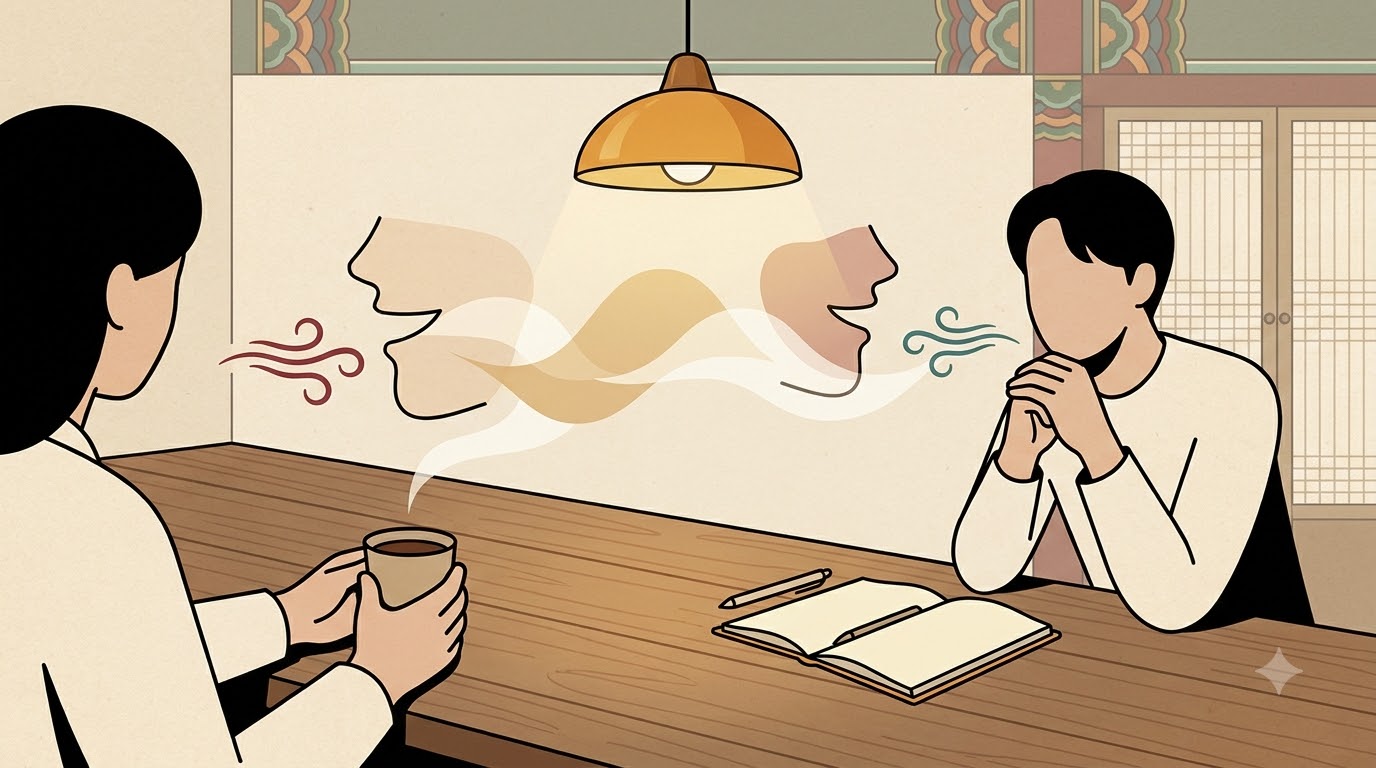
이모 (i-mo) literally means a mother's sister — a maternal aunt. Walk into almost any Korean restaurant, pojangmacha, or traditional market, and you'll hear it applied to women who share no blood with anyone in the room. It is the single most institutionalized example of what linguists call fictive kinship — using family terms for people who aren't actually family.
Calling a server 이모 does something a simple 저기요 (jeo-gi-yo, the neutral "excuse me") cannot. It says: I see you as someone worthy of warmth, not just service. It transforms a transaction into a moment of connection. Many Koreans use it without a second thought, the way a native English speaker says "guys" to a group — it's social reflex, not a conscious decision. But the reflex carries real meaning, and people learning Korean who use it correctly often report an immediate, visible shift in how they're received.
The honorific suffix 님 (nim) elevates it to 이모님 (i-mo-nim) — the form you'd reach for when you want to signal both warmth and respect at the same time. Think of it as the difference between "hey, auntie" and "dear auntie." Both are affectionate; one bows slightly deeper.
언니, and the Alliance It Quietly Forms
언니 (eon-ni) is what a younger woman calls an older woman she feels close to — an older sister, a trusted senior friend. When a shopkeeper deploys it toward a customer she met sixty seconds ago, she's doing something commercially savvy and culturally genuine at the same time.
It drops the wall between seller and buyer. The implicit message is that the shopkeeper isn't pushing product onto a stranger — she's giving honest advice to someone she already considers a friend. Whether the warmth is entirely sincere or partly strategic is a question worth sitting with, but either way, the linguistic move is real and it lands. Female solidarity in Korean social life runs deep, and 언니 is one of its most reliable signals.
삼촌, the Friendly Uncle of the Neighborhood
For middle-aged men in casual, accessible settings — a neighborhood vendor, a taxi driver, a market stall owner — the go-to term is often 삼촌 (sam-chon, "paternal uncle"). It occupies a specific emotional register: approachable, slightly playful, warm but not overly intimate.
The alternative would be 사장님 (sa-jang-nim, "owner/boss") — technically respectful but stiff, the kind of address that keeps distance. 삼촌 does the opposite. It says: you feel like someone I already know. Children use it instinctively for friendly men in their neighborhood. Adults use it to recapture that ease.
When Strangers Become Parents
The logic scales further. For someone who reads as a full generation older — elderly strangers on the subway, a friend's parents — Korean speakers often reach for 어머니 (eo-meo-ni, "mother") or 아버님 (a-beo-nim, "father," in its most respectful honorific form).
This isn't performance. It reflects a genuine cultural instinct: that people old enough to be your parents deserve to be addressed with the warmth of that relationship, not the coldness of bureaucratic neutrality. It's the same logic as 이모 and 삼촌, simply elevated one generation and one register.
Why This Matters Beyond Vocabulary
It would be easy to read all of this as a charming cultural quirk and move on. But the fictive kinship system reveals something deeper about how Korean society has historically managed the friction of living in dense, fast-moving communities.
Urban anonymity is genuinely uncomfortable. Cities are full of people who are strangers to each other, and most cultures develop linguistic tools to handle that — to make transactions feel human. Korean's solution was to refuse the category of "stranger" altogether, at least in the warmth of language. The words 이모, 언니, 삼촌, 어머니, and 아버님 don't just describe relationships. They create them, on the spot, out of nothing but goodwill and syllables.
That said, people are genuinely diverse. Regional habits differ, generational preferences shift, and individual personalities vary — some younger Koreans in urban areas are gravitating toward more neutral forms of address. The underlying instinct to warm up an interaction through relational language is a strong and consistent cultural tendency, not a law that every Korean speaker follows in every context.
What a Learner Can Actually Do With This
Here's the practical upshot: if you want to sound not just grammatically correct but genuinely warm, these kinship terms are worth practicing before almost anything else on your vocabulary list.
The aha moment most learners miss is this — these words aren't just polite alternatives to "excuse me." They are relational acts. When you say 이모님 to a restaurant worker instead of 저기요, you are not simply choosing a different label for the same person. You are briefly, genuinely, placing that person inside your social world. Korean speakers feel that distinction. The language was built so they would.
Start with 이모님 in any restaurant with older female staff. Notice what happens to the face across from you. That small shift — a slight softening, a moment of recognition — is the language doing exactly what it was designed to do.
Not as strangers. Never quite as strangers.

Quick Questions
Why do Koreans call restaurant workers 이모 (auntie) when they're strangers? Korean culture is built around relational language rather than neutral, impersonal address. Calling a restaurant worker 이모님 (i-mo-nim, "auntie") instantly frames the interaction as warm and human rather than purely transactional. It's a form of fictive kinship — using family terms for non-family — and it signals genuine regard for the person, not just their service.
What does 언니 mean when a Korean shopkeeper says it to a customer? 언니 (eon-ni) literally means "older sister" and is used between women. When a shopkeeper says it to a customer she just met, she's collapsing the distance between stranger and friend. It signals that they're on the same side — the shopkeeper is framing herself as a trusted peer giving honest advice, not a salesperson pushing a product.
Is it rude to just say 저기요 instead of using family terms in Korean? 저기요 (jeo-gi-yo, "excuse me") is perfectly grammatical and not offensive, but in many casual Korean settings it can feel noticeably impersonal compared to a kinship term. It's the difference between correct and warm. In a busy local restaurant or market, reaching for 이모님 or 삼촌 (sam-chon, "uncle") tends to make the interaction feel more natural and human to the people you're speaking with.
🔊 Pronunciation Guide
Natural-sounding audio for the Korean in this article. Listen, then shadow out loud.
The exact phrases Koreans actually use every day — with the nuance notes that keep you from sounding like a textbook. Delivered as a beautiful PDF, free.
Send Me the Free PDFNo spam. Unsubscribe anytime.