Why Koreans Say "Our Mom" — Even When Talking About Their Own Mother
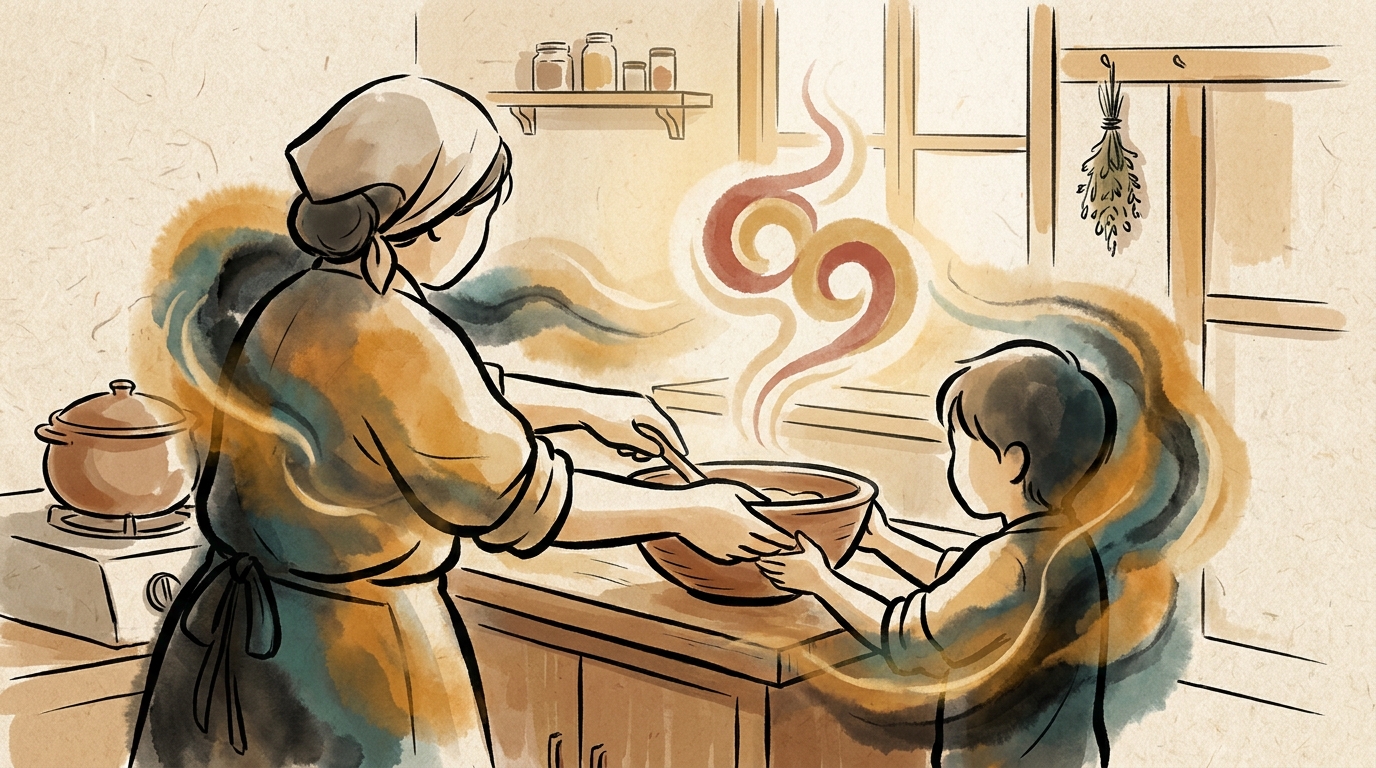
The first time you hear a Korean friend say 우리 엄마 (u-ri eom-ma, "my mom") about their own mother, something short-circuits. Our mom? Are we family now? Did I miss something?
You didn't miss anything. You just ran into one of the most quietly profound things about Korean: the language doesn't just describe relationships. It encodes how Koreans understand the self.
The Word That Breaks English Logic
In English, possession is personal by default. My mom. My school. My country. The "my" draws a clean boundary: this belongs to me as an individual.
Korean doesn't work that way — at least not for the things that matter most.
When a Korean speaker says 우리 엄마 (u-ri eom-ma, "my mom"), they're not suggesting you share a mother. They're expressing something closer to: "the mom who belongs to the unit I am part of." The word 우리 (u-ri, "we / our") isn't just a pronoun here. It's a signal of where the speaker locates themselves in the world — not as a standalone individual, but as a node in a network of relationships.
Here's the thing most textbooks skip entirely: this isn't a quirk or an exception. It's the default. And once you understand why, a huge amount of Korean social logic suddenly makes sense.
The Map of 우리: Where Koreans Use It
The pattern is consistent once you see it. 우리 (u-ri, "we / our") attaches to anything you belong to — and in Korean, belonging is a much wider category than English speakers expect.
Family: - 우리 엄마 (u-ri eom-ma, "my mom") - 우리 아빠 (u-ri a-ppa, "my dad") - 우리 남편 (u-ri nam-pyeon, "my husband") - 우리 아내 (u-ri a-nae, "my wife") - 우리 오빠 (u-ri o-ppa, "my older brother," said by a female speaker)
That middle pair is worth pausing on. A married person will introduce their spouse to a complete stranger using 우리 남편 or 우리 아내 — not 내 남편 (nae nam-pyeon, "my husband"). Dropping the 우리 sounds slightly cold, even clinical, like you're filing paperwork rather than talking about someone you love.
Institutions: - 우리 학교 (u-ri hak-gyo, "my school") - 우리 회사 (u-ri hoe-sa, "my company") - 우리 팀 (u-ri tim, "my team") - 우리 반 (u-ri ban, "my class")
These carry a strong sense of 소속감 (so-sok-gam, "sense of belonging") — and that word is worth sitting with. 소속감 isn't just "membership." It's the feeling of being woven into something larger than yourself. When a Korean employee says 우리 회사 (u-ri hoe-sa, "my company"), there's often genuine pride folded into those two syllables — even when the sentence ends in a complaint about how exhausted they are.
Country and place: - 우리나라 (u-ri na-ra, "our country" = Korea, when said by a Korean) - 우리 동네 (u-ri dong-ne, "my neighborhood")
우리나라 (u-ri na-ra, "our country") deserves special attention. Koreans rarely say 한국 (Han-guk, "Korea") when referring to their own country in casual conversation. They say 우리나라. Always. It's so automatic that most Koreans don't notice they're doing it — which tells you everything about how deeply this collective instinct runs.
The Concept Behind the Word: Collective Self
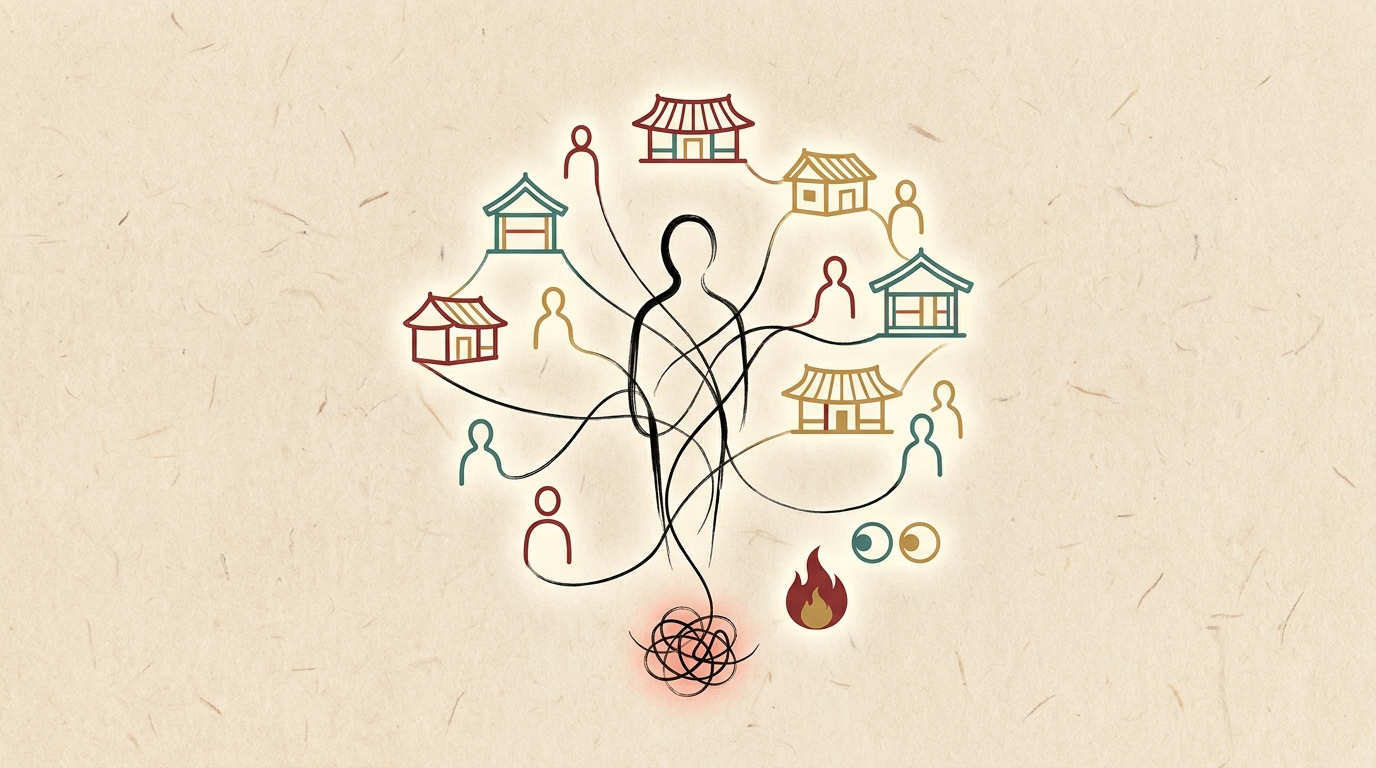
Here's the insight that makes everything click.
In most Western cultural frameworks, the self comes first. You are an individual, and then you have relationships — parent, employee, citizen. The "I" is the core; the relationships are attachments you accumulate.
Korean flips this entirely. The concept called 집단주의 (jip-dan-ju-ui, "collectivism") isn't just a social preference — it's baked into the grammar. In Korean thinking, you are already a son or daughter, already a student, already a Korean, before you are a standalone "I." Your identity is relational from the ground up.
This is why 우리 엄마 isn't a grammatical error or a charming quirk. It's a precise statement about how the speaker understands themselves.
The contrast with English is stark — and this is the aha moment:
English says: I have a mom. Korean says, in effect: I am someone who belongs to a family, and this is that family's mom.
Same person. Same woman. Entirely different frame.
When you say 내 엄마 (nae eom-ma, "my mom"), you're placing yourself at the center and the mother as your possession. When you say 우리 엄마 (u-ri eom-ma, "my mom"), you're placing yourself inside a unit, and naming the mother of that unit. The relationship hasn't changed — but the speaker's position in the sentence has.
When to Use 내, Not 우리
This collective logic doesn't erase the individual. Korean uses 내 (nae, "my") — and knowing when matters just as much.
Personal opinions and feelings stay with 내: - 내 생각엔... (nae saeng-gak-en, "In my opinion...") - 내 느낌은... (nae neu-kkim-eun, "My feeling is...") - 내 경험으로는... (nae gyeong-heom-eu-ro-neun, "In my experience...")
Your thoughts belong to you alone. No group can share them, so 우리 would sound genuinely strange here.
Personal possessions — things you bought, received as a gift, that have no group dimension: - 내 핸드폰 (nae haen-deu-pon, "my phone") - 내 노트북 (nae no-teu-buk, "my laptop")
Contrast situations, when you're explicitly distinguishing yourself from a group: - 내 의견은 달라. (nae ui-gyeon-eun dal-la, "My opinion is different.")
Here, the entire point is that you diverge from the group — so 우리 would contradict the meaning.
The rule of thumb: if the noun is something you belong to, reach for 우리. If it's something that belongs to you alone, reach for 내.
The Feeling Native Speakers Can't Quite Name
Ask a Korean why they say 우리 엄마 instead of 내 엄마, and most will pause. It just sounds right, they'll say. 내 엄마 sounds... cold. Weird.
That instinct is real. 내 엄마 (nae eom-ma, "my mom") is grammatically fine — but in practice, it carries a faint whiff of selfishness, as though you're drawing a fence around your mother and claiming exclusive ownership. 우리 엄마 is warmer, more open. It doesn't exclude anyone; it simply locates you inside a family.
This connects directly to 정 (jeong, "deep emotional bond built through shared time and closeness") — the Korean concept of attachment that grows between people who share life together. When you use 우리 to describe someone, you're signaling that they belong to your circle. They are in. 정 is, in a sense, the emotion that grows when someone moves from being "other" to being part of your 우리.
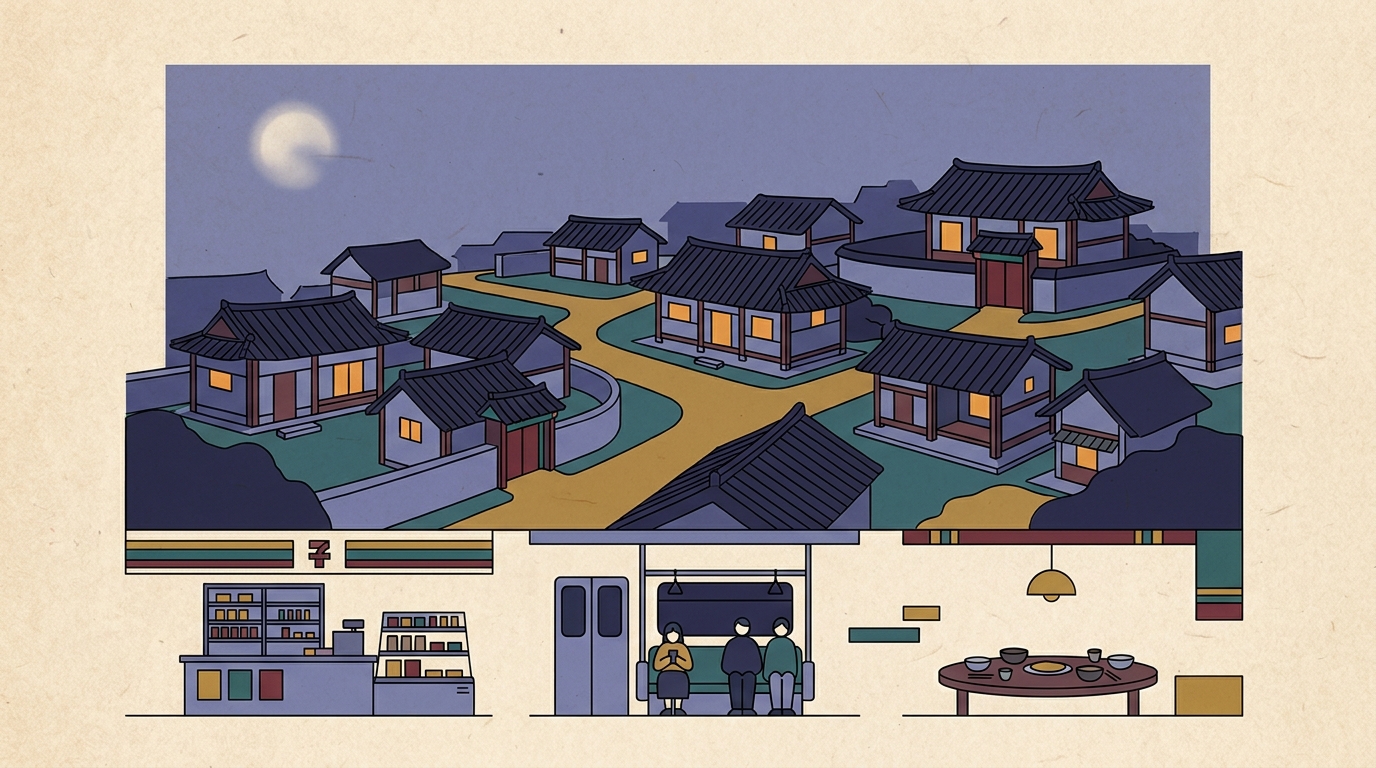
Try This Right Now
The most common learner mistake isn't using 우리 wrong — it's never using it at all. Learners taught that 내 means "my" apply it everywhere: 내 엄마, 내 학교, 내 나라. It's not incorrect, exactly. But it consistently sounds a little stiff, a little foreign — like someone who learned English entirely from textbooks and says "I am not going" where everyone else says "I'm not going."
Here are three swaps you can make in your very next Korean conversation:
1. Talking about family: Instead of → 내 엄마가 요리를 잘해요. (nae eom-ma-ga yo-ri-reul jal-hae-yo, "My mom cooks well.") Try → 우리 엄마가 요리를 잘해요. (u-ri eom-ma-ga yo-ri-reul jal-hae-yo, "My mom cooks well.") The meaning is identical. The warmth is different.
2. Mentioning your school or workplace: → 우리 학교에 카페가 생겼어요. (u-ri hak-gyo-e ka-pe-ga saeng-gyeo-sseo-yo, "A café opened at my school.") → 우리 회사가 요즘 너무 바빠요. (u-ri hoe-sa-ga yo-jeum neo-mu ba-ppa-yo, "My company is so busy lately.")
3. The advanced move — 우리나라: If you're living in or deeply connected to Korea, try saying 우리나라 (u-ri na-ra, "our country") when talking about Korea with Korean friends. Native speakers genuinely light up when a foreigner uses this phrase naturally. It signals something beyond vocabulary — it signals 소속감 (so-sok-gam, "a sense of belonging"). You're not just visiting. You're in.
One caution: if you're a non-Korean learner and use 우리나라 to mean your own home country while speaking Korean, your listener will likely assume you mean Korea. Context matters — when in doubt, use it for Korea and you'll be fine.
Language is never just grammar rules. Every word choice is a small window into how a culture understands the world — and the world's place in the self.
우리 엄마 isn't a mistake or an endearing quirk. It's a Korean speaker telling you, in two syllables, that they understand themselves through their connections rather than apart from them. Once you hear it that way, you'll never mishear it again — and you might find 우리 coming to you more naturally than you expected.
🔊 Pronunciation Guide
Native-speed audio for the Korean in this article. Listen, then shadow out loud.
The exact phrases Koreans actually use every day — with the nuance notes that keep you from sounding like a textbook. Delivered as a beautiful PDF, free.
Send Me the Free PDFNo spam. Unsubscribe anytime.
Comments
Post a Comment