The Word That Explains Why Koreans Can't Just Walk Away

You've seen it happen and couldn't explain it. A Korean friend calls an ex — not to get back together, just to check in. A neighbor who spent years bickering with the family next door gets quiet and a little sad when the moving truck shows up. A restaurant owner slides an extra dish across the table without a word, just a small nod. You're watching something real pass between people, but you can't name it.
The word is 정 (jeong, "an emotional bond that accumulates over shared time, experience, and even conflict"). And the reason dictionaries fail you here isn't a translation gap — it's a conceptual one.
What the Dictionary Gets Wrong
"Affection." "Attachment." "Bond." These are the standard translations, and they're not inaccurate. They're just describing the wrong thing entirely.
Those English words describe emotions you have. Jeong describes something that happens to you. It doesn't ask permission. It doesn't wait for you to decide you care about someone. It accumulates — the way sediment layers at the bottom of a river, slowly and without drama, until one day there's something solid there that wasn't before.
The grammar gives it away. Koreans say 정이 들다 (jeong-i deul-da, "for jeong to form"), and 들다 here is intransitive. The jeong is the grammatical subject. It forms. You're almost incidental to the process.
어느새 정이 들었어 (eo-neu-sae jeong-i deu-reo-sseo, "Before I knew it, jeong had formed") — sit with that sentence structure for a moment. Before I knew it. Not "I decided to care." Not "we became close." The jeong arrived on its own schedule and announced itself after the fact. That's not how English speakers typically talk about forming emotional bonds, and that difference is the whole point.
The Strange Logic of 미운 정

Here is where jeong stops being a translation problem and becomes a genuinely different way of understanding human relationships.
Most emotional frameworks assume that strong bonds come from positive experiences. You enjoy someone's company, you share good times, closeness follows. Jeong doesn't require that. Jeong can form through irritation. Through years of low-level friction. Through the person who has driven you absolutely crazy for a decade.
This is what 미운 정 고운 정 (mi-un jeong go-un jeong, "both annoying jeong and beautiful jeong — the full spectrum of accumulated feeling") captures. 고운 정 is the warm kind, built through shared meals and kindness and easy laughter. 미운 정 is built through arguments, through someone who always chews too loudly or borrows things without asking — and through the sheer accumulated time of having them in your life anyway.
미운 정 고운 정 다 들었다 (mi-un jeong go-un jeong da deu-reo-sseo-da, "Both annoying and beautiful jeong have formed") is not a complaint. It's closer to a confession of helplessness. I know this person frustrates me. I know the history between us is complicated. And something has formed that I cannot simply decide to undo.
This is the aha moment that most Korean learners never get from a textbook: in a jeong-based worldview, conflict doesn't prevent bonding. It can cause it. Time spent together — even difficult time — is still time spent together. The neighbor who argued with the family next door for years didn't bond with them despite the arguments. The arguments were part of how the jeong formed.
Why "I Just Can't Leave" Is a Complete Sentence
Once you understand this, a whole category of Korean behavior stops looking irrational.
정 때문에 (jeong ttae-mu-ne, "because of jeong") is one of the most honest things someone can say in Korean about staying in a relationship they probably shouldn't. 헤어지고 싶은데 정 때문에... (heo-eo-ji-go si-peon-de jeong ttae-mu-ne, "I want to break up, but because of jeong...") — and the sentence trails off. It doesn't need to finish. Every Korean listener already knows the ending. The weight of accumulated shared time — ordinary Tuesdays, difficult moments survived side by side, meals eaten across from each other — has become its own kind of gravity.
This is also why Korean has such specific vocabulary for ending jeong, because ending it is genuinely hard labor. 정 떼다 (jeong tte-da, "to sever the jeong bond") and 정 끊다 (jeong kkeun-ta, "to cut off jeong") are deliberate, effortful acts. You don't drift away from jeong. You have to cut it.
And then there is the final stage: 정나미가 떨어지다 (jeong-na-mi-ga tteo-reo-ji-da, "for even jeong to drop away — being pushed past the point of any emotional investment"). 정나미 is the underlying foundation that allows jeong to grow at all. When that foundation is gone, no new jeong can ever form with this person. It's not anger — anger still has energy in it, still implies you care enough to feel something. 정나미가 떨어지다 is quieter and more final than that. A door closing without a slam. If a Korean person says this about someone in their life, understand: they mean it permanently.
The Jeong You've Already Been Hearing
Here's what tends to land hardest for intermediate learners: you've already encountered jeong-based language. You just didn't have a frame for it.
밥 먹었어? (bap meo-geo-sseo, "Did you eat?") gets taught as a casual greeting, and that's true as far as it goes. But it undersells what's actually happening. Food is the primary medium through which jeong is expressed and maintained in Korean culture. When someone asks if you've eaten, they are, in a small but real way, asking: are you okay? Are we still connected? It is jeong-checking disguised as small talk.
한번 와서 밥 먹어 (han-beon wa-seo bap meo-geo, "Come over sometime and eat") is not an invitation with a date attached. A foreign learner might reach for a calendar. A Korean listener understands this as a warmth signal — evidence that jeong exists between you. Responding by immediately trying to schedule a specific time can feel oddly transactional, like you've missed the point of what was being offered.
And 우리 엄마 (u-ri eom-ma, "our mom") — why does a Korean person say our mom when they mean my mom? This isn't a grammatical quirk. It's jeong culture made visible in language. In a jeong-based worldview, the boundary between mine and ours is genuinely softer. Connection precedes distinction. The collective pronoun isn't imprecise — it's accurate to how the relationship is actually felt.
팍팍하다 — The Texture of a Life Without It
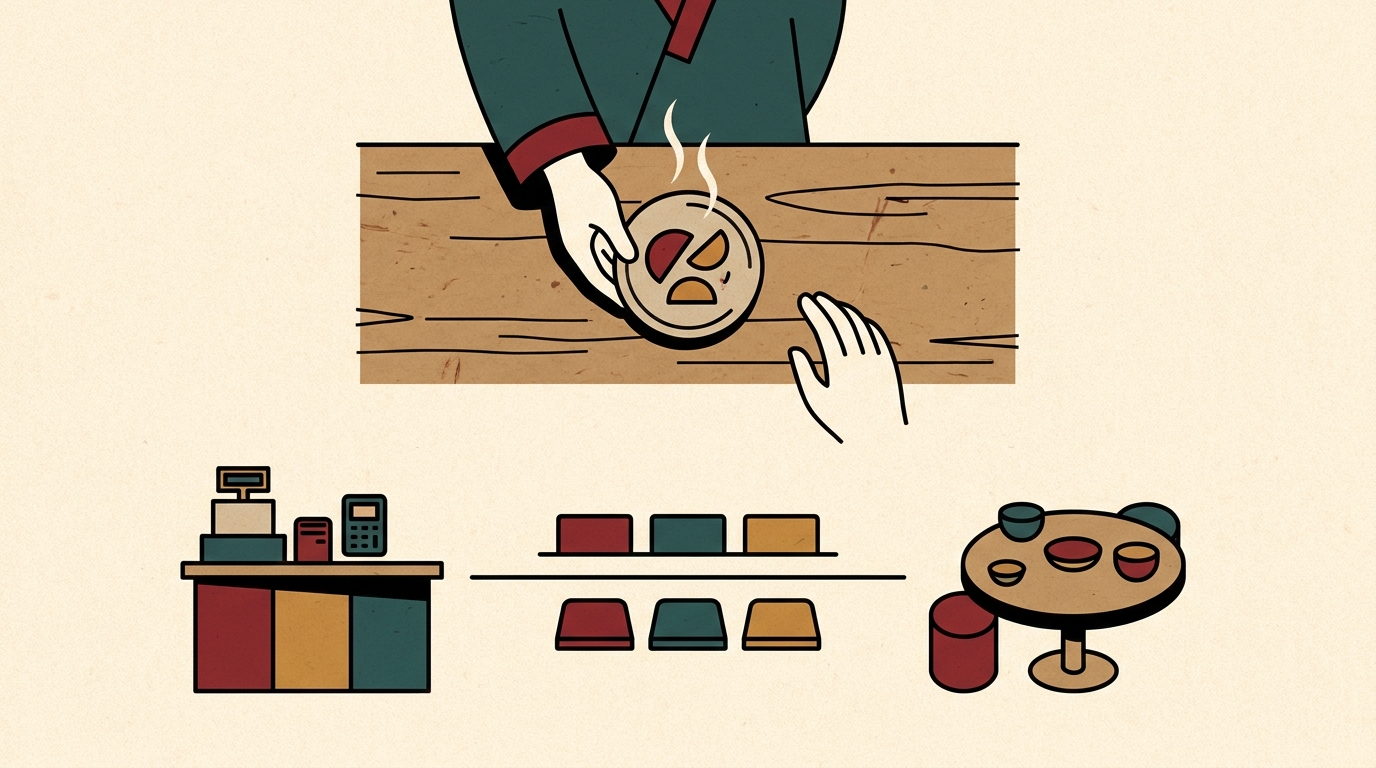
팍팍하다 (pak-pak-ha-da, "harsh, dry, without warmth — a life or environment without jeong") is one of those words that carries a physical sensation into an emotional description. Literally, it evokes something rough and dry — bread with no moisture, cracked earth underfoot. Koreans use it to describe modern urban life: moving through days where no one knows your name, where every interaction is transactional and nothing ever accumulates into anything.
팍팍한 삶 (pak-pak-han sam, "a harsh, dry life") is the direct opposite of a life rich with jeong. And Koreans feel this contrast viscerally. It's part of why 서비스 culture at restaurants carries so much weight.
서비스 (seo-bi-seu, "extra food or items given to regular customers as a gift") sounds like a retention strategy when described in English. In Korean culture, it is something closer to jeong made tangible. When a restaurant owner gives a 단골 (dan-gol, "regular customer") extra 반찬 (banchan, "side dishes") without being asked, they are not calculating lifetime customer value. They are saying, without words: you matter here. Something has formed between us. The right response is not to check your bill. It's to feel the warmth — and return it the next time you walk through the door.
How to Actually Build Jeong — Starting Now
Jeong is not culturally exclusive. It forms through behavior, not ethnicity. And some of what builds it, you can do today.
Go back. Jeong doesn't form in one impressive encounter. It forms across many ordinary ones — the same café, the same greeting, the same face recognizing yours. Be a presence, not a visitor.
Eat with people. If a Korean person offers you food, eat it. If you're buying something, share it without making it a production. 같이 먹어요 (ga-chi meo-geo-yo, "Let's eat together") is an invitation into jeong territory, and accepting it matters more than you might think.
Say yes to 반말. When a Korean friend suggests switching to 반말 (ban-mal, "informal speech"), accept it. This isn't just about being casual — it is a linguistic declaration that jeong has formed between you. Hesitating or declining can feel, from the Korean side, like you're holding the relationship at arm's length.
Receive the warmth correctly. When someone says 언제 밥 한번 먹자 (eon-je bap han-beon meok-ja, "Let's eat together sometime"), the right response is warmth, not logistics. 그래요, 꼭요 (geu-rae-yo, kkok-yo, "Yes, definitely") — and mean it.
Do these things consistently, and something will shift. A Korean person who once treated you warmly but kept a certain distance will start checking on you without a reason. Will remember something you mentioned months ago. Will slide something small across a table with a quiet nod. That's not coincidence.
That's jeong. It arrived the way it always does — quietly, without announcement, before you knew it.
The highest thing a Korean can say about someone from outside Korean culture is short and specific: 정 있는 사람이네 (jeong i-neun sa-ra-mi-ne, "This person has jeong"). It doesn't mean you speak perfect Korean or know every custom. It means you understand how warmth actually accumulates — and you've made room for it to happen. That's the door into Korean social life that no phrasebook can open for you.
🔊 Pronunciation Guide
Native-speed audio for the Korean in this article. Listen, then shadow out loud.
The exact phrases Koreans actually use every day — with the nuance notes that keep you from sounding like a textbook. Delivered as a beautiful PDF, free.
Send Me the Free PDFNo spam. Unsubscribe anytime.