Why 은/는 and 이/가 Aren't About Grammar — They're About Information
You read the textbook explanation. Topic marker. Subject marker. You nodded, moved on, and then froze the next time you tried to form a sentence. The problem isn't you — it's that the explanation was incomplete in the exact way that makes it useless.
Here's why: English doesn't separate "topic" and "subject." They're fused into one word — the subject. So when a textbook says 은/는 marks the topic and 이/가 marks the subject, your brain has no hook to hang that on. There's no English equivalent to feel. You end up guessing, picking whichever looks familiar, and hoping for the best. Almost every learner does this.
But the real distinction isn't about grammatical roles at all. It's about something more fundamental — something you already do in English every time you speak, just invisibly.
The Actual Question: Does the Listener Already Know This?
The difference between 은/는 (eun/neun) and 이/가 (i/ga) is a question of information structure: what's already shared between speaker and listener versus what's being introduced for the first time.
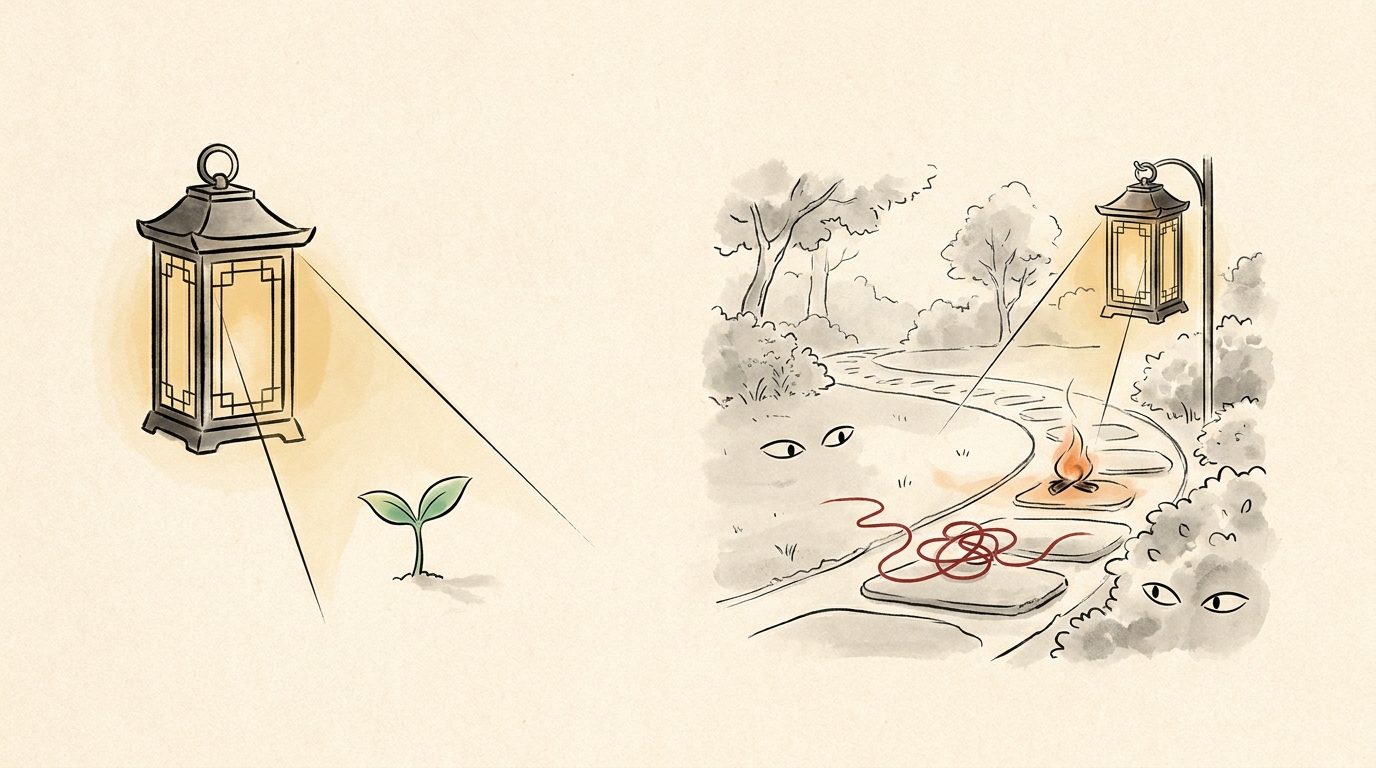
Think of it as a spotlight. 이/가 shines that spotlight directly on the noun — it says, "Pay attention: this is new, or this is the specific one I'm identifying." 은/는 does the opposite — it says, "We already know about this thing. Now let me say something about it." The focus shifts away from the noun itself and lands on what comes after.
A two-sentence story makes this click in a way no grammar chart can:
사자가 왔어요. (sa-ja-ga wa-sseo-yo, "A lion appeared.") 사자는 지금 자고 있어요. (sa-ja-neun ji-geum ja-go i-sseo-yo, "The lion is sleeping now.")
First sentence: nobody was talking about a lion before. It's brand new. 이/가 introduces it into the scene. Second sentence: we already know which lion — the one that just appeared. 은/는 picks it up as established information. Same noun. Same position in the sentence. Completely different marker. That's not arbitrary — that's the system working exactly as designed.
This is the logic native speakers use instinctively and almost never think to explain.
이/가: New Information and Identification
이/가 has two jobs, and they're closely related.
Job 1: Introduce something new.
When a noun enters the conversation for the first time — when there's no shared context for it yet — 이/가 is the natural choice. This is especially visible with verbs of existence and emergence like 있다 (to exist), 생기다 (to arise), and 되다 (to become). Something that appears or exists is, by definition, being introduced:
문제가 있어요. (mun-je-ga i-sseo-yo, "There is a problem.") 기회가 생겼어요. (gi-hoe-ga saeng-gyeo-sseo-yo, "An opportunity has arisen.")
You wouldn't say 문제는 있어요 here unless the problem had already been established in the conversation — or unless you wanted to contrast this problem with something else. More on that in a moment.
Job 2: Identify the specific answer to a "who?" or "what?" question.
When someone asks which person or thing something applies to, 이/가 pinpoints the answer. This is called the identification focus function — the noun with 이/가 is the answer to an implicit or explicit "which one?" question:
누가 했어요? — 제가 했어요. (nu-ga hae-sseo-yo — je-ga hae-sseo-yo, "Who did it? — I did it.") 뭐가 맛있어요? — 불고기가 맛있어요. (mwo-ga ma-si-sseo-yo — bul-go-gi-ga ma-si-sseo-yo, "What's delicious? — Bulgogi is what's delicious.")
Notice that the question itself uses 이/가 — 누가, 뭐가. Korean is consistent: when you're identifying something, the whole exchange uses 이/가. The spotlight lands on that noun, and everything else in the sentence exists to describe it.
은/는: Given Information and Contrast
은/는 does something subtler. It takes a noun the listener already knows about — or can be assumed to know about — and says, "As for this thing, here's what I want to tell you." The noun becomes the 주제 (ju-je, "topic") — the frame for the sentence — and the focus moves to whatever comes after.
This is exactly what linguists mean by 주제 (화제, hwa-je, "topic"): not the most important word in the sentence, but the established starting point. The topic is the context. The predicate is the news.
But 은/는 has a second function that's just as important, and most textbooks underplay it: 대비 (dae-bi, "contrast").
When you mark something with 은/는, you subtly imply "this particular thing — and possibly not others." It creates a soft contrast with things left unsaid. This isn't always dramatic, but it's almost always present:
저는 커피를 마셔요. (jeo-neun keo-pi-reul ma-syeo-yo, "I drink coffee.")
This doesn't just mean "I drink coffee." It carries a quiet undertone: I do — though I can't speak for anyone else. That's the 대비 (dae-bi, "contrast") function. When the contrast becomes explicit, 은/는 appears on both sides:
커피는 좋아요. 차는 별로예요. (keo-pi-neun jo-a-yo. cha-neun byeol-lo-ye-yo, "Coffee is good. Tea, not so much.")
Coffee versus tea. Both marked with 은/는, both held up against each other. The contrast is the whole point of the sentence.
Three K-Drama Lines That Show the System in Action

Real dialogue is faster than any grammar table. Here are three famous lines — each one a clean example of the system at work.
From 이상한 변호사 우영우 (Extraordinary Attorney Woo):
나는 고래가 좋아. (na-neun go-rae-ga jo-a, "I like whales.")
나는 (na-neun) sets the 주제 (ju-je, "topic") — as for me. The sentence isn't making a claim about "me" being special. It's using "me" as a frame. The spotlight falls on 고래가 (go-rae-ga) — whales are the thing I like. The 이/가 identifies what. If someone asked "What do you like?", this is the answer — and the answer always uses 이/가.
From 도깨비 (Goblin):
내가 그 남자야. (nae-ga geu nam-ja-ya, "I am that man.")
내가 (nae-ga) — identification. The implicit question is "Who is that man?" The answer: I am the one. This isn't introducing new information — the man has already been established. 이/가 here is doing its identification job, pinpointing the 주어 (ju-eo, "grammatical subject") as the answer to a "who?" question. If this line used 나는 instead, it would feel like the speaker was just setting a topic — "As for me..." — which would land completely differently, more like a confession than a revelation.
From 사랑의 불시착 (Crash Landing on You):
당신은 남한 사람이에요? (dang-sin-eun nam-han sa-ram-i-e-yo, "Are you from South Korea?")
당신은 (dang-sin-eun) — topic set. You are already present in the conversation, already visible. The speaker isn't introducing you — they're asking something about you. And there's a 대비 (dae-bi, "contrast") undertone that fits the scene perfectly: you specifically, unlike the people around here.
A Decision You Can Run in the Next Five Minutes
Take any sentence you've been unsure about — one you've written before, or one you want to write now. Run the noun through these three questions in order:
1. Is this noun appearing in the conversation for the first time? If yes → 이/가.
2. Is this noun answering a "who?" or "what?" question — identifying the specific thing? If yes → 이/가.
3. Is this noun already known, already mentioned, or are you contrasting it with something else? If yes → 은/는.
Pick three sentences from your last writing practice. Apply the test to each subject noun. If you find yourself uncertain on step 3, ask: would "as for X" make sense as a translation? If yes, 은/는. If the noun feels like it's being spotlighted — like it's the answer — 이/가.
Two mistakes to watch for while you do this: First, many learners default to 저는 (jeo-neun, "I [topic]") at the start of every sentence — including identification contexts. If someone asks who did something, 제가 했어요 (je-ga hae-sseo-yo, "I did it") is the correct answer, not 저는 했어요. Second, some learners assume 이/가 sounds more formal or correct and overuse it in situations that call for 은/는. Neither marker is more polite than the other. They do different jobs.

Why Native Speakers Can't Explain This to You
Here's something worth sitting with: most Korean speakers cannot explain this distinction clearly. Ask a native speaker why 이/가 feels wrong in a certain sentence, and they'll say 어색해 (eo-saek-hae, "It feels awkward") — and stop there. They feel the difference, but they've never had to articulate why, because they absorbed it from thousands of hours of exposure before they could read.
The word 주어 (ju-eo, "grammatical subject") is a term they may have seen in school. The distinction between 주어 (ju-eo, "grammatical subject") and 주제 (ju-je, "topic") is something most native speakers have genuinely never thought about. They don't need to. You do — and that's actually an advantage.
Understanding the logic of a system you're learning consciously can get you further, faster, than pure exposure gets a child. You won't feel it automatically yet. But you can reason your way to the right answer while that feeling develops. That reasoning is what this framework gives you.
Linguists have been debating the full complexity of these markers for decades — there are edge cases that resist clean rules. But for the sentences you'll actually produce as a learner — introducing something new, identifying an answer, talking about something already established, drawing a contrast — three questions are enough. Start there. The feeling will follow.
🔊 Pronunciation Guide
Native-speed audio for the Korean in this article. Listen, then shadow out loud.
The exact phrases Koreans actually use every day — with the nuance notes that keep you from sounding like a textbook. Delivered as a beautiful PDF, free.
Send Me the Free PDFNo spam. Unsubscribe anytime.