답정너 (Dab-Jeong-Neo): The Korean Social Code That Punishes Honest Answers
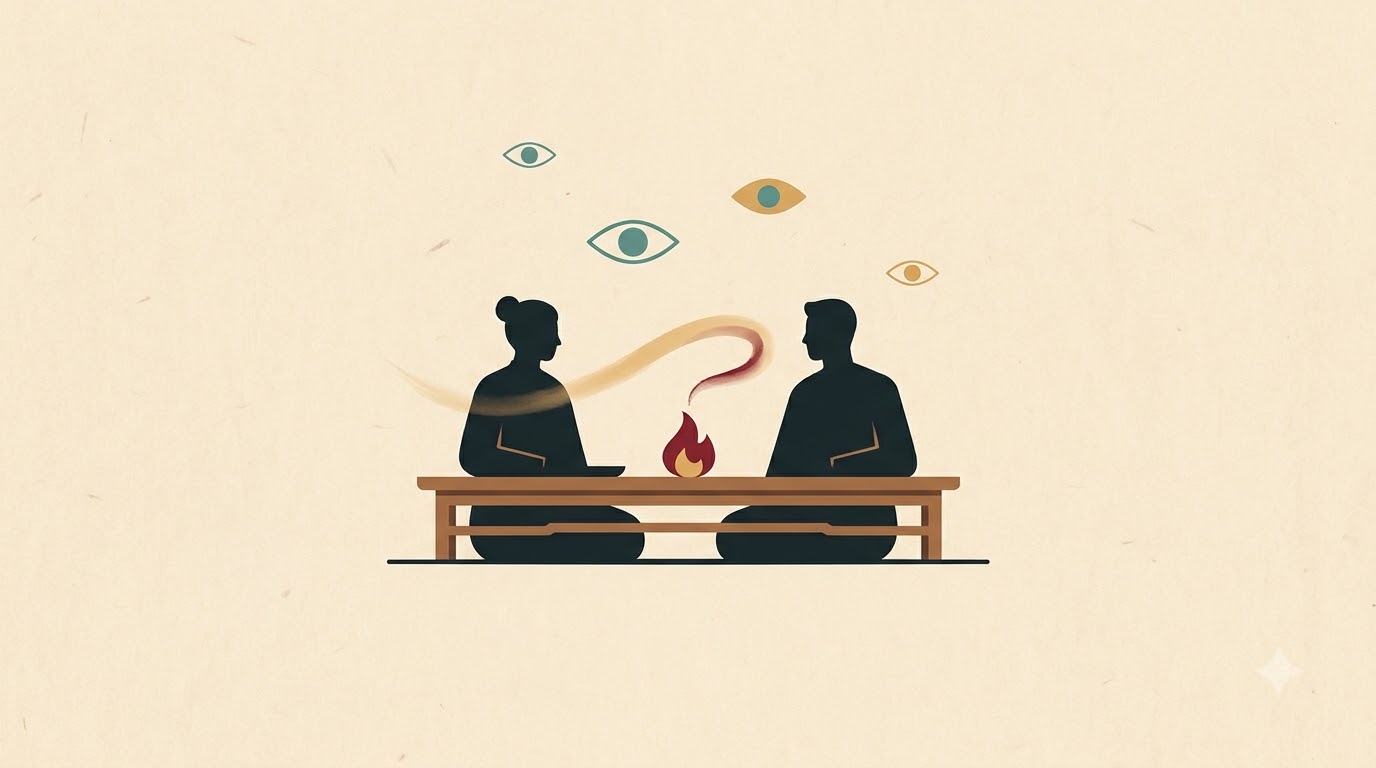
You gave an honest answer. You were gentle about it. And within seconds, something in the air went cold.
If you've felt that specific chill — the one that follows a sincere opinion your Korean friend technically asked for — you've already stumbled into 답정너 (dab-jeong-neo) territory. The part no one warned you about: your honesty wasn't the problem. The problem was that you answered the question that was asked, instead of the question that was meant.
The Sentence That Looks Like a Question but Isn't

답정너 (dab-jeong-neo) is a contraction of 답은 정해져 있고 너는 대답만 하면 돼 (dab-eun jeong-hae-jyeo it-go neo-neun dae-dab-man ha-myeon dwae, "The answer is already set — your only job is to say it"). It started as self-aware internet slang — someone playfully admitting they already knew what they wanted to hear. But the social machinery it describes is far older than the internet, and far more consequential than a meme.
Here's the linguistic core, and this is the thing most textbooks will never tell you: in Korean conversation, a grammatically interrogative sentence frequently has zero interest in the information it appears to request.
When a friend asks 나 오늘 머리 좀 이상하지? (na o-neul meo-ri jom i-sang-ha-ji?, "Is my hair a bit weird today?"), she has already stood at the mirror. Probably for a while. She is not conducting a hair quality survey. The question is doing something else entirely — it's asking: "Will you confirm that I'm okay? That we're still okay?"
This is the reframe that changes everything: many Korean questions are not information requests. They are temperature checks on the relationship itself. The moment you answer with objective data instead of emotional warmth, you haven't been helpful — you've failed the actual test, which was never about hair.
What's Really Driving the Question: 불안
The hidden engine underneath nearly every 답정너 moment is 불안 (bul-an, "anxiety or insecurity that drives indirect questioning"). And once you see it, you can't unsee it.
When someone asks 나 살찐 것 같지 않아? (na sal-jjin geot gat-ji anh-a?, "Don't you think I've gained weight?"), they are not asking you to assess their body. They are experiencing a spike of 불안 (bul-an) and reaching toward you to quiet it. The question on the surface is about weight. The question underneath is: "Do you still accept me?"
This is why reducing 답정너 to "fishing for compliments" or "emotional manipulation" completely misses the point. The person asking isn't trying to trick you. They're asking for reassurance without wanting to appear needy enough to ask for it directly. The indirect question is the elegant solution — it lets both people maintain face while the anxiety gets addressed.
That dynamic — protecting everyone's dignity while still meeting an emotional need — is not a character flaw. It's a sophisticated social technology.
Three Moments Where Honesty Becomes a Landmine
The pattern shows up in predictable situations. Not to memorize scripts, but to recognize the shape:
The style check: 이 옷 사지 말까? (i ot sa-ji mal-kka?, "Shouldn't I buy this?") — asked while already picturing wearing it. The expected answer is warm and decisive: 아냐, 예쁘니까 무조건 사! (a-nya, ye-ppeu-ni-kka mu-jo-geon sa!, "No way, it's gorgeous — definitely get it!"). A measured 응, 비싸기도 하고 너한테 안 어울려 (eung, bi-ssa-gi-do ha-go neo-han-te an eo-ul-lyeo, "Honestly it's expensive and doesn't really suit you") is technically accurate and socially devastating.
The body check: 나 살찐 것 같지 않아? is arguably the most famous 답정너 format. The expected move is to contradict the content while validating the feeling: 아니야, 오히려 빠졌는걸? (a-ni-ya, o-hi-ryeo ppa-jyeot-neun-geol?, "No, if anything you look slimmer"). Notice what's happening — you're disagreeing with the words while agreeing with the need underneath them. That's not dishonesty. In Korean close friendship, that's loyalty.
The post-decision debrief: This is the one that surprises people most. The choice has already been made — the job has been accepted, the argument has been had, the purchase is done. Your friend isn't asking for a retrospective audit. They're asking you to stand beside them. Offering critique now doesn't land as good advice. It lands as abandonment.
It's worth saying clearly: not every Korean person operates this way in every situation. People are genuinely diverse, and plenty of close Korean friendships run on blunt, direct feedback by mutual agreement. What's described here is a deeply common social tendency — one you'll encounter often enough that missing it has real consequences — not a fixed rule about how all Koreans communicate.
The Three Forces Running Simultaneously
When a 답정너 exchange happens, three things are operating at once:
Validation Seeking (확신 구걸): Your friend is using your words to patch over 불안 (bul-an). This is human and universal — we all seek reassurance. In Korean social dynamics, this process is often verbal and fairly direct: you surface the anxiety as a question, your friend provides the emotional fuel, and the anxiety subsides. The system works when both people understand the protocol.
Harmony Maintenance (조화의 유지): When you deliver the expected 칭찬 (ching-chan, "praise or positive reinforcement expected in social rituals"), you're not just complimenting a haircut. You're performing an act of 동의 (dong-ui, "agreement, or mirroring of emotional stance") — signaling "we're on the same side." In many Western contexts, compliments are specific and somewhat rare, which makes them feel weighty. In Korean friendship dynamics, immediate positive reinforcement to a leading question is a baseline signal of solidarity. Withholding it doesn't feel neutral. It feels like a verdict.
The Trap of Honesty (솔직함의 부작용): When you deliver an objective, well-intentioned honest answer, the message your friend receives isn't "they're being helpful." It's "they don't understand what I needed." Repeated often enough, that becomes a quiet conclusion: "This person and I aren't really on the same emotional wavelength." The chill you felt isn't anger. It's a careful, private recalibration of how much emotional intimacy is safe to offer you.
Reading the Room: What You Can Actually Do Right Now
Before responding to any question with even a faint emotional charge, run through this:
Is the decision already made? If your friend is wearing the haircut, holding the receipt, or recapping the fight they already had — the ship has sailed. Your role is no longer evaluator. It's co-signer. Matching someone's emotional reality in this moment isn't dishonesty; it's the specific form of loyalty the moment requires.
Is the question about data or 불안 (bul-an)? 나 오늘 발표 잘 했어? (na o-neul bal-pyo jal haet-eo?, "Did I do well in my presentation today?") asked immediately after, with nervous eyes — that's anxiety speaking, not a performance review request. Provide 칭찬 (ching-chan) and warmth now. If you have genuinely useful feedback, offer it later, in a calm moment, when they explicitly ask for it.
What is the question doing to their face? If someone asks with a self-deprecating laugh or slightly downcast eyes, they've already half-answered it themselves. They're asking: "Will you contradict my worst fear about myself?" Almost always, the right answer is yes.
The one-line shortcut: If you can hear 불안 (bul-an) underneath the words, address the anxiety — not the literal content of the question.
The Reframe That Makes This Make Sense
Here is what Korean native speakers understand intuitively but almost never articulate: 답정너 (dab-jeong-neo) isn't about being deceived. It's closer to what you might call a 귀여운 투정 (gwi-yeo-un tu-jeong, "an endearing, slightly petulant plea for affection"). Think of it as the verbal equivalent of a cat headbutting your hand for attention — slightly demanding, completely transparent, and met with warmth rather than a lecture on emotional independence.
When you deliver the expected warmth in a 답정너 moment, you are not compromising your integrity. You are demonstrating that you understood the real conversation — the one about connection, not content. You're showing that you can read not just the sentence, but the person behind it.
The mistake isn't honesty. The mistake is treating every question as a request for information, when some questions are requests for presence.
Once this clicks, you'll start hearing Korean conversations differently — not just the words, but the emotional architecture running underneath them. You stop being a learner parsing grammar and become a participant reading the room.
That gap — between speaking Korean and being understood in Korean — is exactly where 답정너 lives. And now you know the way through it.
🔊 Pronunciation Guide
Natural-sounding audio for the Korean in this article. Listen, then shadow out loud.
The exact phrases Koreans actually use every day — with the nuance notes that keep you from sounding like a textbook. Delivered as a beautiful PDF, free.
Send Me the Free PDFNo spam. Unsubscribe anytime.